
This doesn't "hand Trump the win"
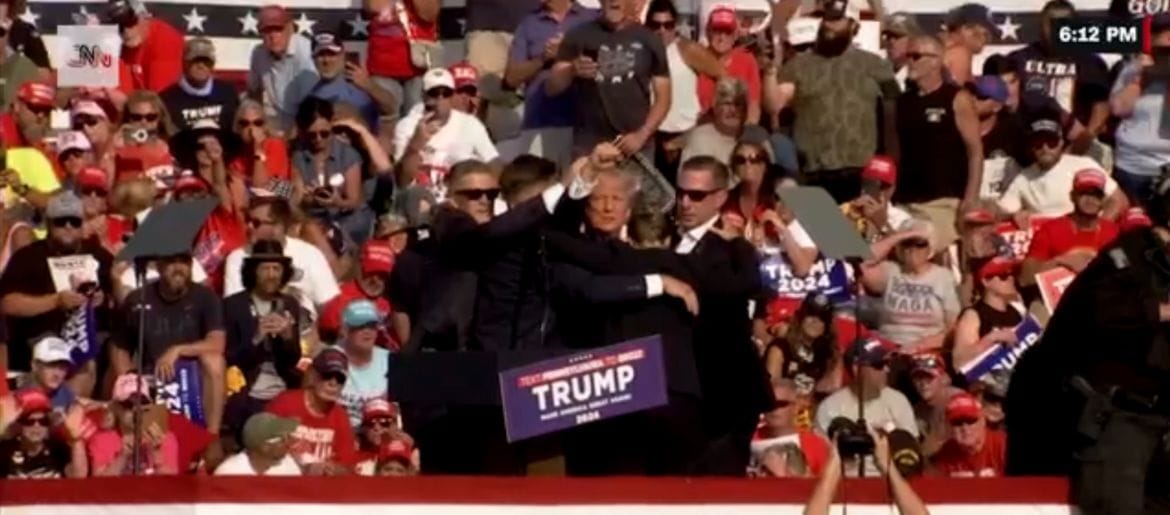
Unpacking the assassination attempt
This is an excerpt! Read the full article here.
There is something that’s been bugging me about the early reporting, commentary and analysis that’s emerged in the wake of the attempted assassination of former U.S. President Donald Trump. Many people are saying this moment – and the immediately historic picture of it – will win the election for Trump. This assessment is coming from both experts and everyday people across the political spectrum; whether they’re pleased, dismayed or neutral about the idea of a second Trump term, it’s delivered with certainty.
But this isn’t a footrace where the winner is decided solely on their own preparation and performance. The voting public determines the outcome. So when someone says “this moment guaranteed Trump will win”, what they’re really saying is that the moment will persuade more people to vote for Trump.
I’m not sure that argument entirely holds up because of how U.S. Presidential elections are typically decided.
Focus on six states
The outcome of the election is expected to be decided by the results in just seven ‘swing’ states: Arizona, Georgia, Michigan, Nevada, Pennsylvania and Wisconsin and North Carolina. The state where the attack occurred, Pennsylvania, is particularly important as it contributes the highest number of votes (19) to the final result under the electoral college system.
As much as it makes for good content, the fact that die-hard Trump supporters in states like Kansas or Florida view him as a living martyr won’t make too much of a difference. It’s equally irrelevant if voters in New York or California think Trump’s own rhetoric contributed to the attempt on his life. Voting along party lines is so entrenched in these states, they are unlikely to ‘flip’ to the other side.
And within the swing states, it’s only the opinion of a small group of voters that will matter at the end of the day. According to Axios, the Democrats are using a “’6% of six states’ formulation as a proxy for how narrow a group of voters are considered truly in play.” Republicans are also focusing on a very small cohort: “A Trump insider told us that persuadable voters are below 10% in every battleground: ‘I think it’s probably 6% in Wisconsin but 8% in Michigan, and lower in Arizona.’”
Persuading existing voters – notnewvoters
There is an important word within that statement: persuadable. America’s non-compulsory voting system plays a role, with around 40% or more of eligible voters choosing not to participate (with the exception of the 2020 election, with a record 67% eligible voter turnout).
It means the 2024 election is unlikely to be determined by convincing new voters to go to the polls, but persuading the existing yet undecided voters. New York Times columnist and former political correspondent on Jamelle Bouie expands on this point on TikTok, pointing out that ‘new voters’ in the 2020 election were evenly divided between Trump and Biden, therefore having no significant impact on the result.
“Undecided voters are [those] who are not only not paying attention, but don’t know that much about the process or anything going on. So what tends to happen is they tend to tune in [during] the fall, and they tend to make their decisions at the last moment.”
This is the group that Biden persuaded to get him over the line in the 2020 election – not because they necessarily supported or even liked him, but because they decided at the last minute that Trump was not an acceptable option.
What will persuade these voters?
🔗 Click to read the rest of this piece 🔗
Zee Feed is 100% independent, progressive, proudly intersectional and feminist. If you believe Australian media needs a voice like ours, share this newsletter with a friend. 1 share = 1 virtual hug.


